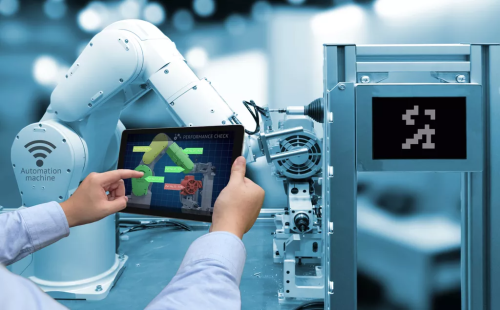
AI has evolved from large servers to applications closer to daily life, including factory automation, railways, unmanned systems, environmental monitoring, healthcare, and education. As computing shifts from servers to edge nodes, the advantages of real-time processing, low latency, and localized handling drive the demand for compact devices.
Unlike data centers, localized environments are more complex, placing higher demands on power solutions. For fanless systems, or when airflow is prioritized for system boards, power supplies must be compact yet capable of delivering stable high power under high temperatures.
With the growing demand for high computing power and versatile deployment in AI applications, Cincon power solutions focus on several key application priorities:
- Versatile operation
- EMC compliance
- High stability
- High efficiency
- Compact size and ease of installation
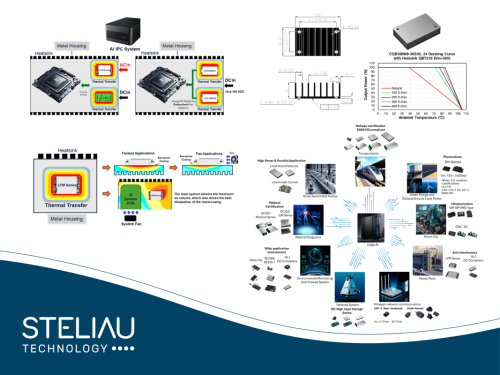
In terms of versatile operability, Cincon offers various solutions for IPC applications. Examples include 54V to 56Vdc brick modules for PoE+, dual-input designs supporting both AC and DC input, current sharing or redundant configurations, and more. For harsh wide-temperature environments, most products are designed with baseplate cooling, enabling designers to allocate more thermal management capacity to the main system.
The IPC metal chassis provides a greater heat dissipation area for the power supply. Cincon baseplate cooling design power supplies, when securely mounted to a large-area metal chassis, will perform better than the derating specifications listed in the product datasheet.
For example: The CQB100W8-36S (Input Voltage: 9–75V, 8:1 ratio) combined with the QBT210 Heat Sink. Under fanless conditions, this DC-DC converter could deliver 100W output (full load) at approximately 40℃. When the airflow is 400 ft./min., it can operate at full load in ambient conditions of over 80℃.
If the system"s metal chassis is larger than the power supply"s standard heatsink, it greatly helps achieve fanless operation in harsh environments. It also allows fan-assisted applications to operate in high temperatures with less airflow.
When fan cooling is prioritized for the main system, baseplate cooling design power supplies offer a key advantage over standard L- or U-bracket power supplies (whose heatsink size is often limited by safety certifications). The design uses the baseplate to conduct heat to the metal chassis, which is then cooled by the airflow, ensuring more stable and reliable power quality.
Industrial-grade power supplies feature IEC, EN, and UL certifications, high reliability, wide-temperature operation, and wide DC input voltage. The full product range undergoes MIL-STD-810F shock and vibration testing and is CE certified. For EMI, all AC products pass Class B conducted and radiated testing. Related EMC guidelines and test information are provided in the DC Brick Application Note.