The Cell Connection System (CCS) from SRXTronic, part of the Steliau Technology group, has established itself as an advanced solution for electrical connection and data acquisition in battery modules. It enables precise cell interconnection, optimising energy efficiency, thermal safety and structural integration in electric mobility and energy storage applications.
Types of CCS Solutions
-
Busbar
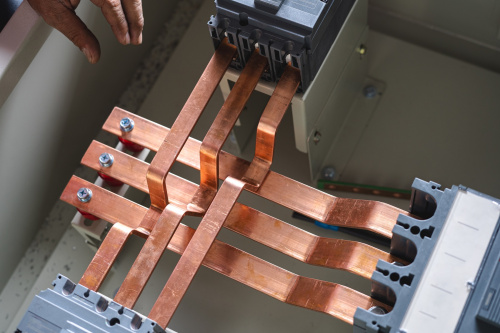
Establishes the main electrical connection between cells. Manufactured in aluminium, copper or nickel with nickel-plated surface treatments to improve conductivity and corrosion resistance. Some models incorporate laminated dielectric layers that reduce thermal losses and ensure uniform current dispersion.
-
HV Connector
High-voltage connectors that provide a safe interface between modules and the vehicle's power system. They incorporate high-insulation plastic materials and thermally controlled metal contacts.
-
Integrated CCS (Complete System)
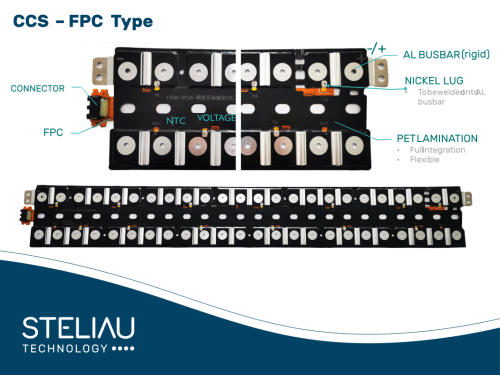
Combines busbars, fuses, NTC temperature sensors, connectors and FPC/PCB circuits. Facilitates integration with the BMS system, achieving accurate measurements of voltage, temperature and current balance between cells.
CCS-FPC Types and How They Work
CCS-FPC (Flexible Printed Circuit) is an evolution of the traditional harness system. It replaces wiring with a flexible laminated circuit that incorporates conductive tracks, sensors and electronic components.
- Materials and structure: PET or PI (polyimide) sheets laminated with etched or nickel-plated copper.
- Integration: hot pressing, laser welding and automated assembly processes.
- Functions: temperature and voltage acquisition via integrated sensors (NTC), direct communication with the BMS and uniform current transfer.
- Technical advantages: high electrical consistency, minimal weight, high mechanical strength (>100 N tear strength and >300 N shear strength) and excellent thermal stability.
There are also advanced variants such as FDC (Flexible Die-Cut Circuit), a more economical and environmentally friendly version of FPC, which reduces manufacturing costs and eliminates the use of corrosive chemicals.
Main Components
- Busbar: nickel-plated copper, aluminium or pure nickel with optimised thickness to minimise resistance.
- Insulation: PET, PI, NOMEX or PA66 materials, depending on thermal requirements.
- Signal circuits: PCBA, FPC or flexible flat cables (FFC) integrated with voltage and temperature sensors.
- Structural housings: injection-moulded flat holders or thermoformed trays to integrate the assembly.
Manufacturing Process
The production process for a CCS combines several highly automated stages:
cutting and stamping of metal sheets, ultrasonic or laser welding, thermal lamination with insulating films, insertion of NTC sensors, electrical and insulation testing, and laser coding for complete traceability.
In FPC and FDC systems, multi-layer lamination and hot pressing ensure a uniform structure free of bubbles or hot spots.
Key Advantages of CCS-FPC
- High functional integration: combines electrical connection, sensorization and protection in a single structure.
- Safety and reliability: incorporate protective fuses and thermal sensors.
- Lightweight and reduced volume: replaces heavy wiring with flexible flat circuits.
- Full automation: adapted to high-volume automated production lines.
- Improved heat dissipation: flat design promotes uniform current flow.
- Optimised total cost: fewer components and greater assembly efficiency.
Applications
New-generation CCS systems are used in battery packs for electric vehicles (EV and HEV), energy storage solutions (ESS) and industrial equipment. Their modularity allows them to be adapted to cylindrical, prismatic or blade configurations, ensuring performance, safety and durability in demanding environments.
Related product news:
👉 CCS technical details
👉 More about Busbars
👉 SRX Tronic mechanical solutions