Selecting the right TIM (Thermal Interface Material) for your project.
Engineers facing a thermally critical design for the first time—whether due to the application, component placement, or high power dissipation—are often confronted with a wide range of materials, heat sink geometries, and airflow solutions. This variety can quickly become overwhelming.
In such situations, or when addressing issues related to thermal stress and aging caused by prolonged exposure to high temperatures, expert guidance becomes essential.
The engineers of Steliau Technology’s Thermal & Adhesives division have been supporting customers since 1992, combining long-standing experience with the latest technologies to validate solutions and design fully customized thermal management components.
Why use a TIM?
At a microscopic level, surfaces are never perfectly smooth. Even when a component is pressed against a heat sink, surface irregularities create micro air gaps that prevent optimal contact.
Since air has a very low thermal conductivity, these gaps significantly reduce heat transfer efficiency. The role of a TIM is to eliminate air pockets and create a homogeneous thermal path between surfaces.
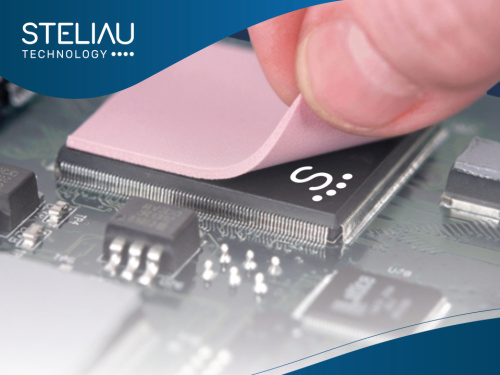
Thanks to their physical properties, TIMs conform to the microscopic and nanometric irregularities of mating surfaces, improving thermal contact and ensuring efficient heat dissipation.

What information is needed to choose a TIM?
Selecting the right TIM is not straightforward. Steliau Technology’s catalog includes over 2,000 references, and the choice depends on more than just thermal conductivity or thermal resistance.
Key parameters to consider include:
- Contact pressure
- Surface roughness
- Whether the surface is completely flat. (Difference in height between components on the PCB)
- Operating Time
- Operating Temperature
- Material thickness
-
Gap-filling capability
Therefore, before deciding which material to use, we must answer certain questions:
- - What are the components between which the TIM is located? “Component to be cooled and heat sink that has been decided to be placed.”
- - Are the components in contact or is there a gap to fill?
- - How thick is the gap between the component and the heat sink? Nominal + min. and max. tolerance.
- - How is the component mounted on the heat sink? Screws, clips, etc.
- - Is there an impression and/or dimensions of the TIM available? Depending on the materials, this will allow us to make a component-specific element, saving material and cost, as well as guaranteeing the quality of the final product.
- - What is the total heat/power (in W) generated by the component to be dissipated?
- - Is a thermal resistance (Rth) or thermal conductivity value expected from the TIM?
- - Is electrical insulation required?
- - EAU/SOP project data, sample/prototype, and L/T
With this information, we can now look at the range of TIMs to use:
Thin interface pads are standard products offering high thermal conductivity (0.8–3.0 W/m·K). They are available with film or fiberglass reinforcement, with or without silicone, and in electrically conductive or insulating versions.
They are often used where high dielectric strength is required, but they require sufficient contact pressure to maintain performance.
A key advantage is the ability to custom-design pad shapes, optimizing material usage and cost.
Phase change pad where the viscosity of the material changes depending on the temperature (around 50-60ºC). Depending on the product range, it can be found in traditional pad format or as so-called high-performance greases. This variety allows us a performance range between 1.0 - 4.0 W/m-K, which is why it is often used in high-computing applications. To use these pads, the assembly process must be clear, as the placement of screens, templates, and pads must be planned, as well as the electrical insulation requirements.
Thermally conductive putty is also a standard product with performance levels between 1.0 and 8.0 W/m-K, which can be found as curable materials (using two components) or pre-cured materials (a single material). Both formats offer solutions with and without silicone.
Its use is recommended for large production volumes, and a material dispenser is required for optimal use.
The use of this solution has the fundamental advantage that the pressure exerted on the TIM has virtually no effect on its deflection compared to conventional pads.
These compounds are evolving thanks to research into new materials to provide higher thermal performance and greater softness, or what this characteristic implies, greater reworkability.
Gap Pads are pads that not only allow heat dissipation, but also level areas in mixed component layouts on a PCB. Standard materials with thermal conductivities between 0.8 and 20.0 W/m-K and thicknesses of up to 6.5 mm are available, with or without a silicone base.
Their design is tailored to the application in terms of both shape and thermal conductivity. One of the advances being promoted in the materials industry is the combination of thermal performance with EMI absorption, making this type of solution very attractive for all kinds of applications.
Applications and Support
Thanks to the wide range of thermal solutions available, TIMs are used in applications such as:
- Power supplies and DC/DC converters
- Battery chargers and UPS systems
- Power LEDs
- EV and transportation electronics
- Industrial and household appliances
These solutions serve markets including industrial, medical, Hi-Rel, telecommunications, lighting, and transportation.
Each application presents unique challenges. With decades of experience, Steliau Technology provides thermal simulations, CFD analysis, and expert consulting, helping customers reduce development time and optimize thermal performance.
Our advanced simulation tools enable accurate thermal modeling of electronic systems, allowing the Thermal & Adhesives engineering team to deliver tailored, high-performance thermal management solutions.